DORE
DORÉ BLOGWhy Combining Onda Lifting and Retaining Ligament Filler Is a Good Idea
Why Combining Onda Lifting and Retaining Ligament Filler Is a Good Idea
The best combination for deep cheeks and jawline lifting! From what each treatment does, to order, intervals, and precautions
The changes in which the jawline blurs and the cheek fat around the mouth slides down usually come from two overlapping factors. One is fat accumulating or shifting under the chin and in the deep cheeks, and the other is the structure that supported that weight loosening. So repeating only one treatment easily leaves the disappointment of 'the fat came off but it still looks saggy' or 'the volume is filled but the face looks heavier.'
Onda lifting is a treatment that uses microwave energy (2.45 GHz) to selectively heat subcutaneous fat, reducing fat cells and contracting collagen, while the treatment commonly called retaining ligament filler is an approach that injects filler into the skeletal areas where the retaining ligaments attach to reinforce the tissue's support. One reduces weight, and the other builds up the support.
So what actually changes when the two are done together, in what order and at what intervals should they proceed, and how far can you expect results? We have organized this around the questions we hear most often during consultations at DORE Clinic.
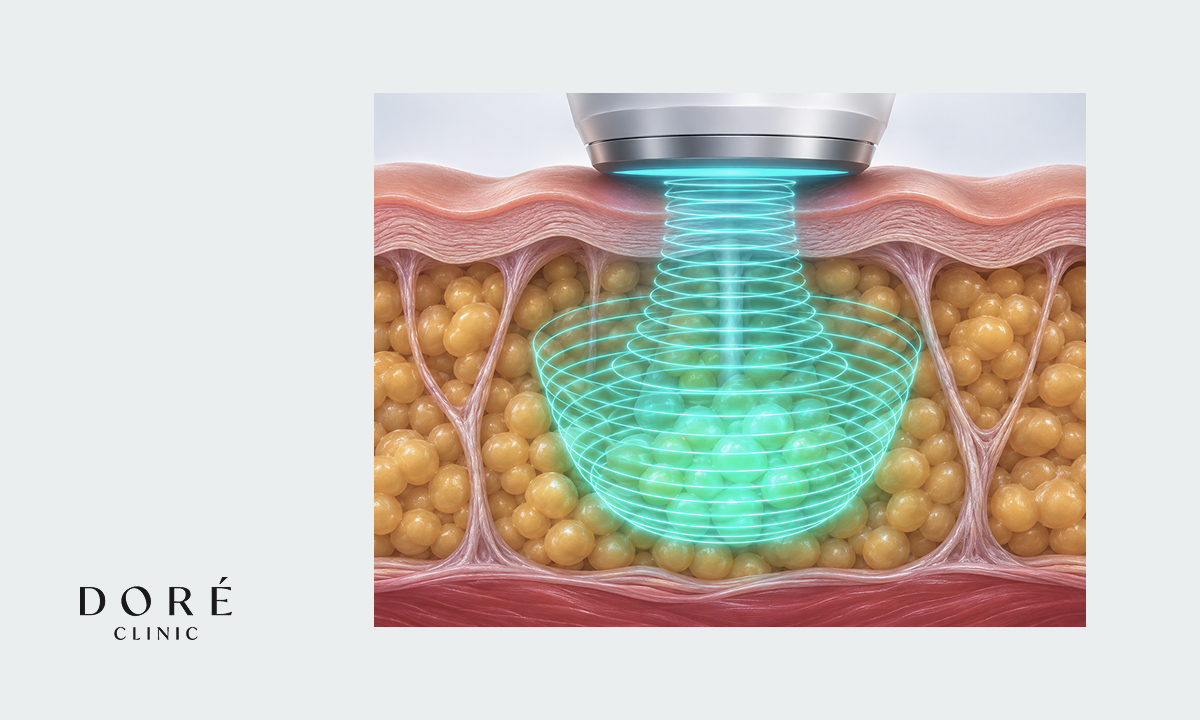
Q1. What kind of treatment is Onda lifting?
Onda lifting is a non-invasive contour and elasticity treatment. It uses 2.45 GHz microwaves, a frequency with a higher absorption rate in subcutaneous fat than in skin or muscle, so it has the characteristic of concentrating heat selectively in the fat layer. Because the epidermis is kept cool by contact cooling and a temperature sensor, it is described as having less burden of pain and heat sensation than methods that heat the surface first.
There are two handpieces. The 3 mm is used on thin facial areas such as the chin, cheeks, and cheekbones, and the 7 mm on areas that need fat reduction. Even with the same device, results differ depending on which handpiece is applied at what intensity, so checking the thickness of each area comes first.
The action is explained in two directions. In the fat layer, fat cells receive heat, the fat content escapes, and the cells are destroyed; in the dermis, collagen fibers contract and then rearrange, improving elasticity. Collagen production is reported to become substantial from 1-2 weeks after treatment, with changes appearing over about 3 months.
However, Onda lifting is closer to a treatment that 'reduces weight and tightens the skin.' It suits areas where fat is the cause well, but it cannot resolve shadows caused by insufficient volume or problems with skeletal support. This is where the combination with retaining ligament filler becomes necessary.
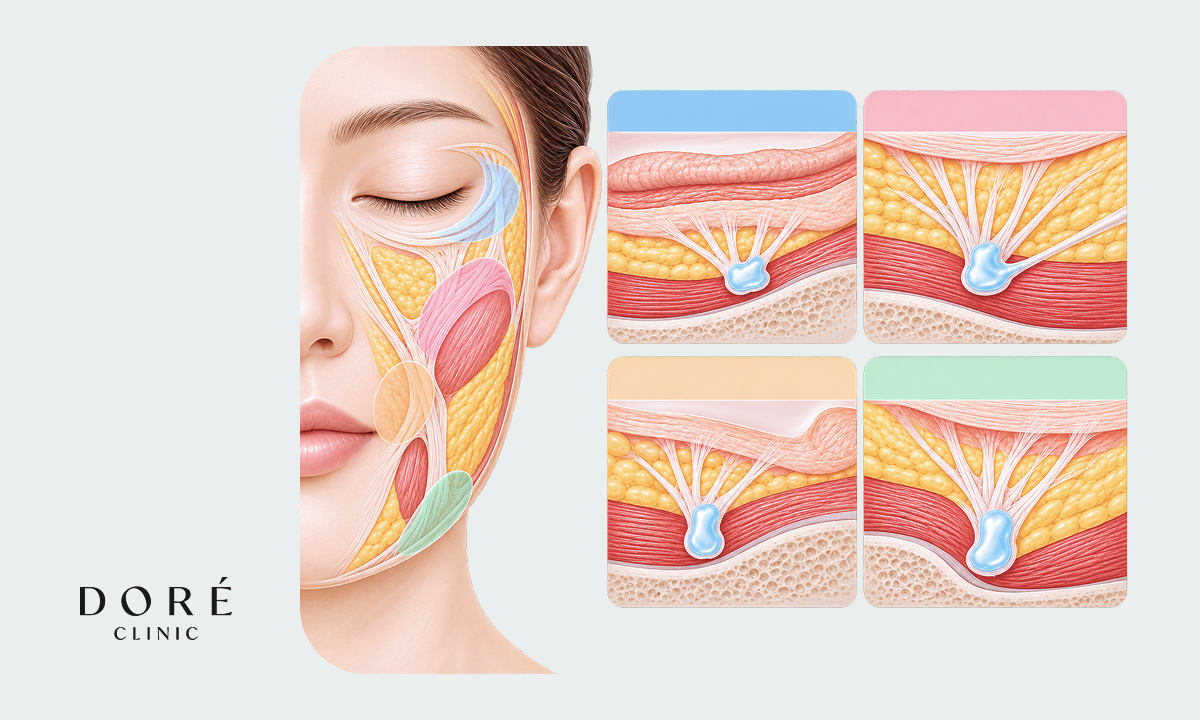
Q2. What kind of treatment is retaining ligament filler?
The retaining ligament is a fibrous structure that connects the skin and soft tissue to deeper tissue and the skeleton. Representative examples are the orbital retaining ligament around the eyes, the zygomatic retaining ligament in the cheekbone area, and the mandibular retaining ligament along the jawline. It acts like an anchor that holds tissue so it does not slide down under gravity.
It is often said that 'the retaining ligaments stretch and cause sagging,' but in actual aging, atrophy of surrounding fat, displacement of soft tissue, and skeletal change are cited as larger causes than the ligaments themselves. That is why a perspective that re-examines the whole facial structure is needed rather than an approach that only pulls the ligaments.
The most important fact here is that filler does not pull or strengthen the ligaments. Filler is a substance that fills space; it replenishes volume in the skeletal areas where the ligaments attach, and as a result supports the tissue. It is closer to reinforcing the footing under a column than to pulling the column up. So 'reinforcing the support base of the retaining ligament' is more accurate than 'injecting filler into the retaining ligament.'
Q3. Why is it good to receive both treatments together?
The two treatments address two different causes separately. For a double chin, fat accumulation under the chin and reduced skin elasticity are cited as the main causes; for deep cheeks, reduced elasticity and gravity-driven fat displacement. In other words, both 'weight' and 'support' have given way at the same time.
Onda handles the weight. By reducing fat cells and contracting collagen, it tidies both the volume that created the sagging and the looseness of the skin. Filler handles the support. It replenishes the volume that was supporting tissue where fat has left or on the skeleton. When you reduce the weight first and build the support on top of that, the result can be more natural even with the same amount of filler.
In practice, with Onda lifting alone the jawline becomes slimmer but the front of the cheek looks hollow or shadows remain around the mouth. Conversely, with filler alone the volume is filled but the feeling that the face looks heavier remains. Designing the two treatments by layer can compensate for these two disappointments.
Exaggeration should be avoided, however. Doing both does not physically pull up loosened skin, and since Onda reduces fat, in a face that needs volume the hollowing can actually become more pronounced. The combination is most effective when 'areas where fat is the problem' and 'areas lacking volume' exist together in one face.
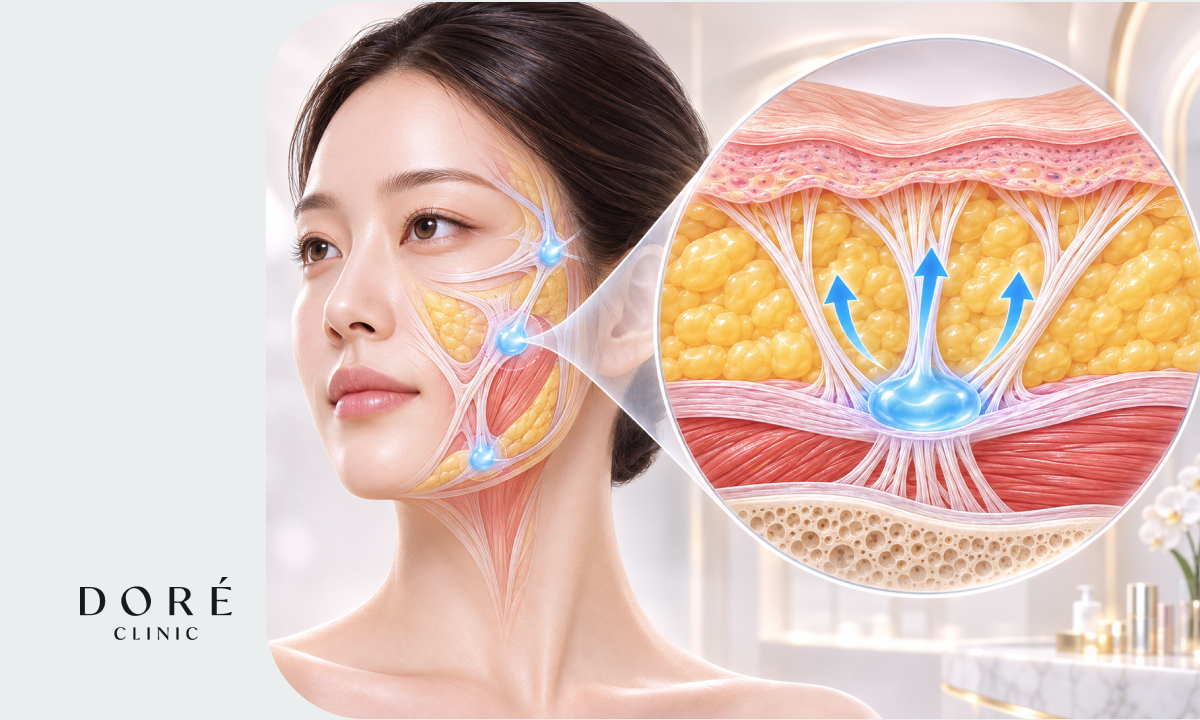
Q4. How is each applied to the deep cheeks and the jawline?
Even with the same combination, the division of roles differs by area. The deep cheeks are an area where fat displacement and reduced elasticity overlap, so Onda carries more weight, while the jawline and mouth area are areas where the supporting structure has given way, so the role of filler becomes more important.
The deep cheeks in particular require caution. Because the fat layer in the cheeks is thin, applying the 7 mm handpiece excessively can create hollowed cheeks. Conversely, adding filler to a face that already lacks volume can make the face look wider. So the process of first deciding, area by area, what to reduce and what to fill is necessary.
Q5. What about pain, downtime, and side effects?
Because Onda keeps the epidermis cool while heating only the deeper layers, pain is described as relatively low, around 2-3 on a 10-point scale. Treatment time is about 20-40 minutes depending on the area, and redness and warmth may remain for 2-4 hours afterward, but there is usually almost no downtime that interferes with daily life.
With filler, bruising or swelling may remain for about 1-3 days depending on the injection site; to avoid intravascular injection accidents, the principle is to inject while avoiding anatomically risky areas, and this depends on the practitioner's understanding of anatomy.
What requires particular caution with Onda is hollowed cheeks. Applying the 7 mm handpiece excessively to an area with thin fat, or repeatedly heating the same area, can make the cheeks look hollow. Because these side effects mostly stem from insufficient facial mapping and energy setting before treatment, checking the fat thickness of each area is important.
The following points are checked for safe treatment.
You inform us of medications you are taking (such as anticoagulants), allergies, autoimmune diseases, and whether you are pregnant or breastfeeding.
For Onda, the authenticity of the handpiece and the delivered energy (kJ) are confirmed; for filler, authenticity and the product and volume are confirmed.
For about one week after treatment, avoid saunas, alcohol, strenuous exercise, and strong pressure or massage.
Swelling right after treatment generally improves within 1-3 days.
Because the skin is sensitive right after a heat-based treatment, if you want to receive another treatment on the same area in succession, you must consult the medical team.
Q6. When do results begin, and how long do they last? How does DORE Clinic approach this?
With Onda, some tightness or contour change appears right after treatment, collagen remodeling proceeds and becomes substantial from 1-2 weeks later, and results are reported to appear over about 3 months. Fat reduction likewise emerges gradually over several weeks. Filler takes effect right after injection and becomes most natural over the 2-4 weeks it takes to settle.
Regarding duration, Onda is described as 6 months to 1 year after collagen changes over about 3 months, and filler as 6 months to 1 year or more depending on the product and area, but the variation is large. Even for the same treatment, the perceived period differs with fat distribution, skin thickness, weight changes, and lifestyle habits, so it is difficult to state definitively based on the stated period.
DORE Clinic views this combination not as 'a lineup of a device and an injection' but as 'a single structural design.' We first divide the face into areas where fat is excessive and areas where volume is lacking, and then allocate each treatment's role on that basis.
Specifically, we observe four points.
First, facial mapping. We check the fat thickness of each area and the cause of sagging, and decide the handpiece, the delivered energy, and the filler points.
Second, confirmation of authenticity and quantity. We check the handpiece and the product, and record the amount used.
Third, order design. So that heat and injection do not interfere with each other's recovery, we map out the intervals in advance and guide you accordingly.
Fourth, avoiding overcorrection. We approach areas to reduce sufficiently and areas to fill with the minimum amount, avoiding results in which the face looks wider or hollowed.
Of course, the same combination is not the right answer for everyone. If volume deficiency rather than fat is the main concern, or if skin laxity is the main cause, a different order may be better. A combination has meaning when the cause is clear, and we conduct consultations on the premise that results vary between individuals.
If you are considering Onda lifting and retaining ligament filler, rather than which treatment to receive, first find out where in your face is the weight to reduce and the support to build.
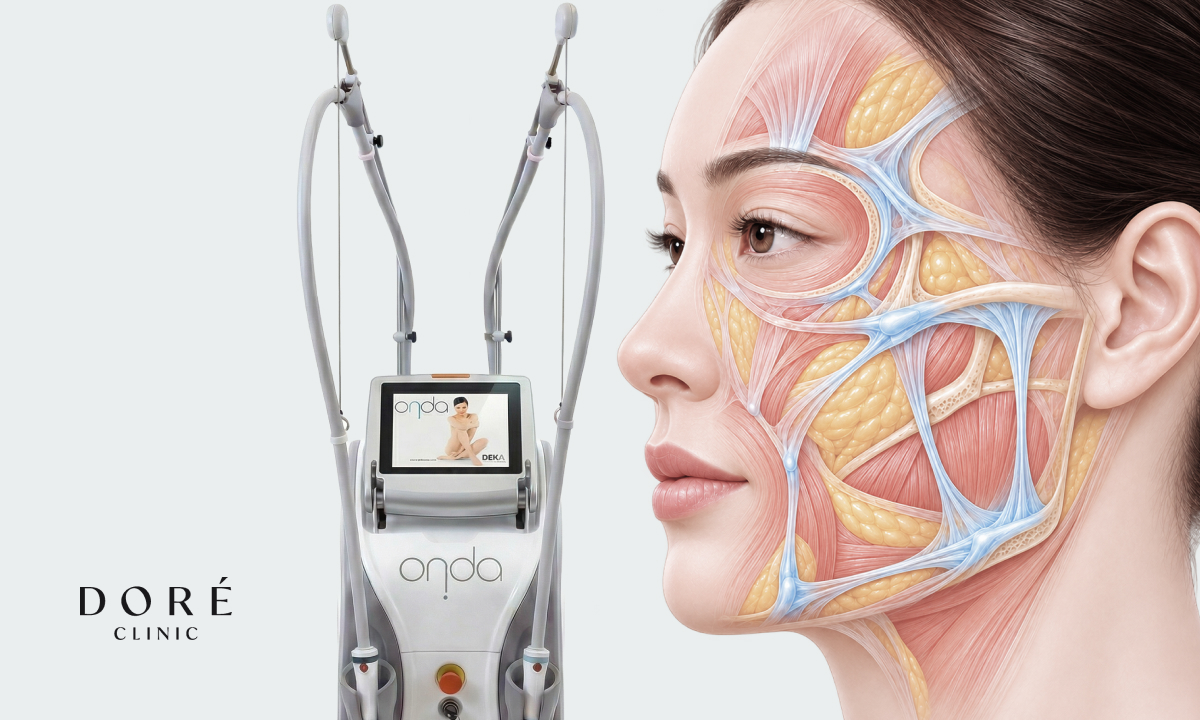
DORE CLINIC | Onda Lifting + Retaining Ligament Filler
Weight by Onda, support by retaining ligament filler.
Ask about DORE Clinic's combination design, which first divides the areas to reduce and the areas to fill through facial mapping.
This content is intended to provide general medical information; the suitability and expected results of an actual treatment must be confirmed through a consultation and examination with a medical professional.

Doctor · Lifting Center, Anti-aging Center
Consultation and Reservation Inquiries
Please feel free to contact us with any questions you may have.