DORE
DORÉ BLOGWhat Treatments Help Enlarged Nose Pores?
What Treatments Help Enlarged Nose Pores?
Clearing pores and tightening pores are not the same.
Understand five treatment options, how to combine them and what to watch for.
Concerns about pores on the nose and surrounding “butterfly zone” generally involve two different problems. One is a buildup of sebum and dead skin cells that makes pores look dark or clogged. The other is enlargement of the pores themselves, making them appear as visible openings. The first calls for clearing; the second calls for tightening. They cannot necessarily be addressed with the same device.
Simply listing treatment names can therefore make choosing difficult. A blackhead laser may leave enlarged pores unchanged, while a collagen-stimulating treatment may leave existing sebum blockages in place. The right sequence depends on the current condition of your pores.
So which treatments are available, what does each one do, and how should they be combined? Here's a guide based on questions we often receive during consultations in Gangnam, Seoul.
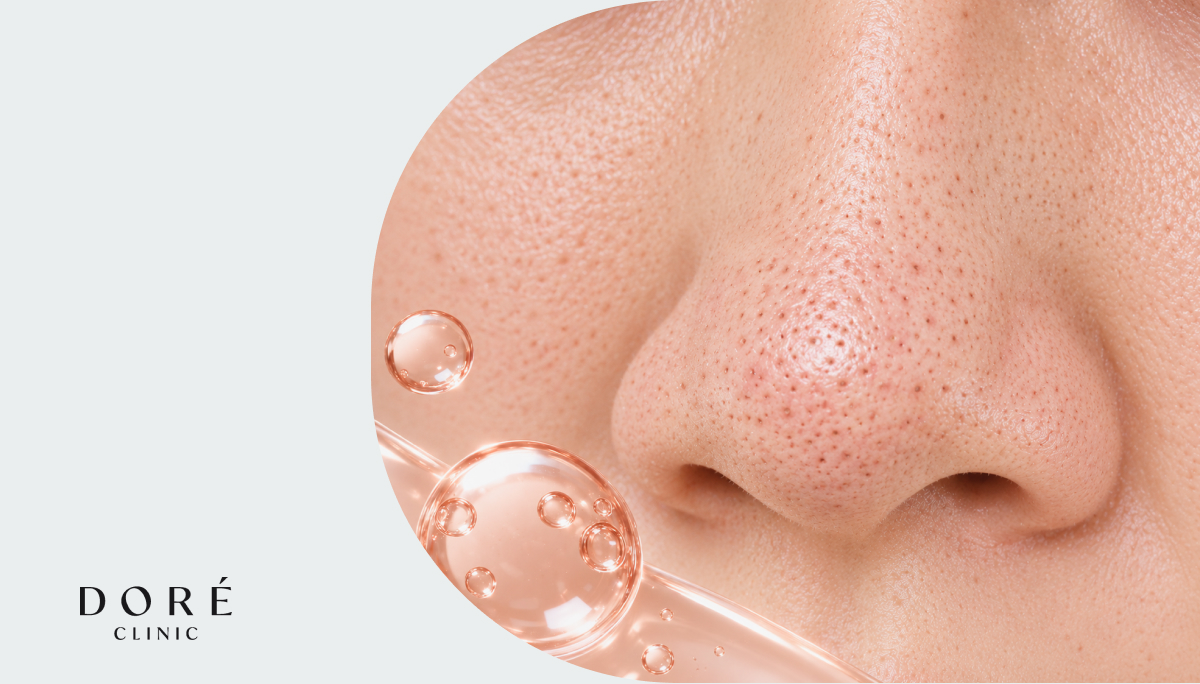
Q1. Why do nose pores become noticeable?
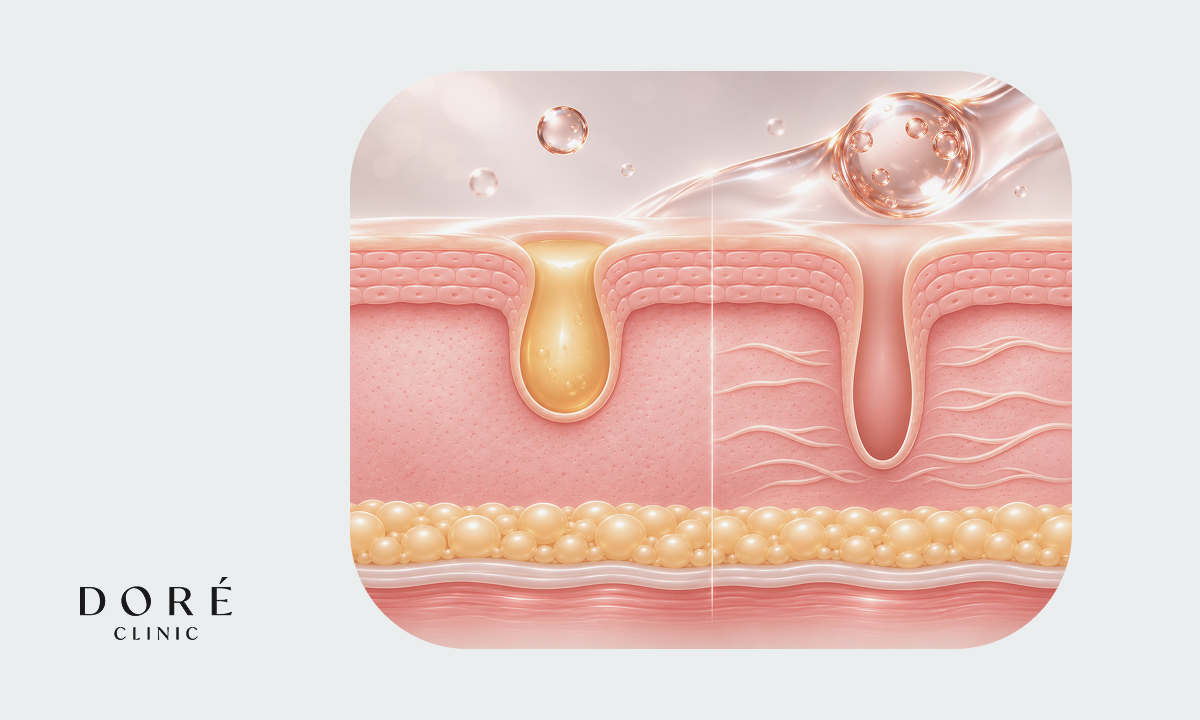
Pores are channels through which sebum reaches the skin's surface. Their apparent size is influenced by sebum production, the buildup of dead skin cells and the elasticity of the surrounding skin. When these factors overlap, pores become more noticeable.
The first issue is clogging. When sebum production is high but drainage is poor, sebum and dead skin cells accumulate inside the pore. As this material oxidizes, it appears dark and forms a blackhead. The pore is clogged, and the nose area may also tend to look red or oily.
The second issue is enlargement. Ongoing sebum buildup can stretch the pore wall, while a decrease in collagen and elastin weakens the surrounding support. Pores can then look like visible openings even without a blockage. This process may accelerate with age and cumulative UV exposure.
That's why a consultation should establish whether clogging, enlargement or both are the main concern, rather than simply labeling the problem “large pores.” Different causes call for different devices and treatment sequences.
Q2. Which treatments may help nose pores?
For nose pores, it helps to group treatments into three categories: clearing blockages, tightening enlarged pores, and improving skin texture and the supporting dermal structure. In practice, two or three approaches are often combined.
Aqua Peel and CocoClear focus on clearing. Aqua Peel uses solutions and suction to cleanse the skin surface and pores, while CocoClear uses laser energy to target blackhead pigmentation and sebum. For tightening and structural support, options include Potenza with the Pumping Tip, which combines microneedling and radiofrequency energy, as well as injectable products such as Juvelook and Re2O that aim to support collagen regeneration.
Treatment | Primary Role | Features |
CocoClear | Primary Role | Dual 755 nm and 1064 nm wavelengths; cooling reduces discomfort |
Aqua Peel | Removes Dead Skin Cells and Sebum | Three-step treatment using AHA/BHA solutions and vacuum suction |
Potenza Pumping Tip | Dermal Stimulation and Product Delivery | Microneedling with RF and product delivery through microchannels |
Juvelook | Collagen Regeneration | PDLLA 170 mg + HA 30 mg; gradually breaks down |
Re2O | Supports Dermal Density | Human acellular dermal matrix (hADM), 5 cc; three sessions at 3–4-week intervals |
As the table shows, each treatment has a different target. Collagen treatments alone may leave clogged sebum untouched, while repeated cleansing alone won't necessarily reduce already enlarged pores.
Q3. How does CocoClear treat blackheads?
CocoClear is a laser system for blackheads that combines two wavelengths. The 755 nm wavelength interacts with melanin to target dark pigmentation in blackheads, while the 1064 nm wavelength delivers heat into the dermis to encourage collagen regeneration.
It does not rely on forcefully squeezing blackheads or pulling them out with an extractor. Instead, it aims to address sebum in the pores with less intense surface irritation. Patients are generally advised that they may wash their faces and apply makeup soon after the procedure. A built-in cooling system also means that numbing cream is often unnecessary.
However, the expected maintenance period is relatively short, commonly described as around two weeks to one month. Skin texture may change after a single session, but three or more sessions are often recommended for more consistent results. Because sebum production continues, regular maintenance is more realistic than expecting a permanent solution after one treatment.
For approximately one week afterward, avoid scrubs, peels, saunas and strenuous exercise. Additional irritation while the skin is sensitive may cause redness to persist longer.
Q4. How does the Potenza Pumping Tip work on pores?
Potenza combines ultrafine microneedles with radiofrequency (RF) energy. Once the needles enter the dermis, energy is delivered through their tips to initiate a collagen-remodeling response. The device offers monopolar and bipolar RF at 1 MHz and 2 MHz, allowing the depth and tissue response to be adjusted.
The Pumping Tip is one of its interchangeable tips. As the microneedles create channels in the skin and are withdrawn, a pressure difference helps push a product into the dermis. In other words, it adds product delivery through the microchannels to the usual process of creating tiny openings and applying heat. Unlike individual manual injections, evenly spaced microneedles allow more uniform distribution of delivery points.
For nose pores, the combination has two intended effects. RF heat stimulates collagen around the pore openings to support tightening, while the delivered product may help improve skin texture and hydration. It does not physically extract blackheads, so if clogging is significant, cleansing first, or separating the treatments in an appropriate sequence on the same day may be preferable.
Redness and mild swelling may occur immediately after treatment and typically subside within one to three days. Small crusts may also develop, so avoid vigorous rubbing for two to three days and make sure to apply adequate sun protection.
Q5. What roles do Juvelook and Re2O play?
Juvelook is a collagen-stimulating injectable that contains PDLLA (poly-D,L-lactic acid) and hyaluronic acid (HA). According to the product specification described here, it contains 170 mg of PDLLA and 30 mg of HA, for a total of 200 mg. HA provides initial hydration and is absorbed over several weeks, while the porous PDLLA gradually breaks down and stimulates fibroblasts, encouraging collagen and elastin synthesis.
Juvelook therefore works gradually. Improvements in texture and the density of the skin surrounding pores may be more noticeable two to three months after treatment than immediately after injection. Rather than simply filling visible pores, the goal is to rebuild the supporting structure around them.
Re2O is a skin booster in Hugel's Elravie line. It delivers human acellular dermal matrix (hADM) directly into the dermis. This is derived from human skin with cells removed and the extracellular matrix retained, providing a framework to support the skin's own repair process. A commonly described course is 5 cc per session, repeated three times at intervals of three to four weeks.
Both address the firmness and density of the skin surrounding pores, but their ingredients and mechanisms differ. Juvelook uses a synthetic polymer to stimulate collagen production, while Re2O uses a human-derived matrix to support the dermis. Neither is universally better: the choice depends on skin thickness and past treatment responses. It's also worth noting that long-term evidence for Re2O is still accumulating.
Q6. How does DORÉ CLINIC in Gangnam combine treatments, and what precautions matter?
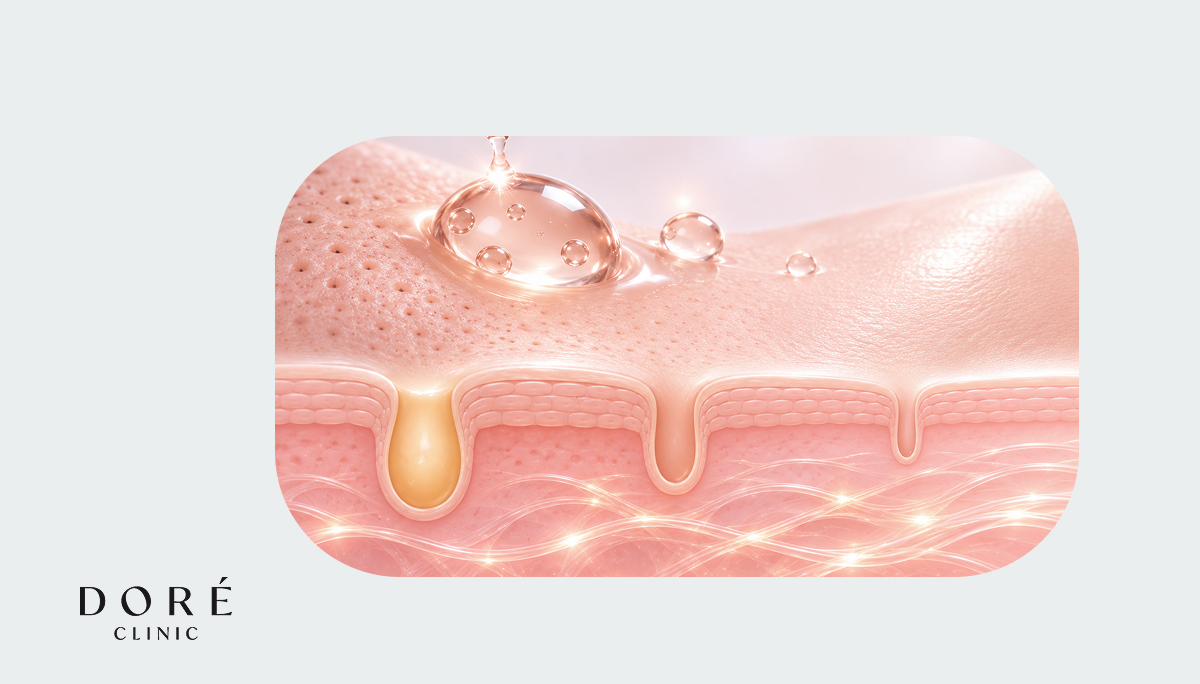
The guiding sequence is “clear, tighten, then reinforce.” If collagen-stimulating treatments are performed while sebum remains clogged, the environment in which the product acts may be uneven. Applying heat to inflamed skin can also increase irritation. For this reason, we generally start by clearing pores with Aqua Peel or CocoClear, follow with Potenza Pumping Tip for thermal stimulation and product delivery, and then consider Juvelook or Re2O to support dermal density.
Not every step needs to be combined at every visit. For patients in their 20s and 30s with heavy sebum production, clearing treatments may be prioritized. For patients over 40 whose pores have enlarged mainly because of reduced elasticity, tightening treatments may receive greater emphasis. When several treatments are performed on the same day, appropriate spacing based on the skin's response is important for safety.
There are also clear precautions. Postpone treatment if the area is inflamed or infected. Always disclose pregnancy, breastfeeding or the use of anticoagulant medication. With human-derived products such as Re2O, the possibility of foreign-body reactions should be explained beforehand. Because nodules are possible with both Juvelook and Re2O, dividing doses appropriately is a safer approach.
Confirm product authenticity and what was actually used (tip type, number of shots and product volume).
For one week after treatment, avoid scrubs, peels, saunas and strenuous exercise, and use sun protection.
If redness or swelling persists, or you feel a nodule, do not squeeze it yourself; return to the clinic for assessment.
At DORÉ CLINIC in Gangnam, Seoul, the sequence is tailored to each patient. First, we determine whether nose pores are mainly clogged, enlarged or both. Second, we decide which of the five treatment options should come first, rather than stacking them all at once. Third, we compare photographs taken under the same conditions before treatment, at four weeks and at three months. Pores can look very different depending on lighting and angle, so consistent photography is essential for meaningful evaluation.
Of course, pores will not disappear completely after a single treatment. Sebum production continues, and collagen responses vary from person to person, so ongoing maintenance is part of the process. We believe explaining that from the outset is an important part of a good consultation.
If you're considering a nose-pore treatment, begin by asking whether your pores are primarily clogged or enlarged, not which device is supposedly the best.
DORE CLINIC | Nose Pore Treatments
Clear. Tighten. Rebuild.
Visit DORÉ CLINIC in Gangnam, Seoul, for a personalized treatment plan based on the condition of your nose and butterfly-zone pores.
This content is intended to provide general medical information; the suitability and expected results of an actual treatment must be confirmed through a consultation and examination with a medical professional.

Doctor · Lifting Center, Anti-aging Center
Consultation and Reservation Inquiries
Please feel free to contact us with any questions you may have.