DORE
DORÉ BLOGWhat Is an Exosome?
What Is an Exosome?
From the signals cells send, to how it is used as a skin booster, to what to check during consultation
These days you hear the word 'exosome' at least once in a dermatology consultation. It is often described as a component derived from stem cells that is good for skin regeneration. Yet it is rare for anyone to explain together what an exosome actually is, and which products can be used in Korea.
An exosome is a very small membrane vesicle that a cell releases outward. It contains signaling substances such as proteins and nucleic acids, and is used as a means for cells to exchange information. Research on using these signals for skin regeneration has been active recently, but conditions remain to be cleared between the research stage and actual clinical practice.
So by what principle does an exosome act, and what should you check before choosing one? We have organized this around the questions we hear most often in consultations in Gangnam, Seoul.
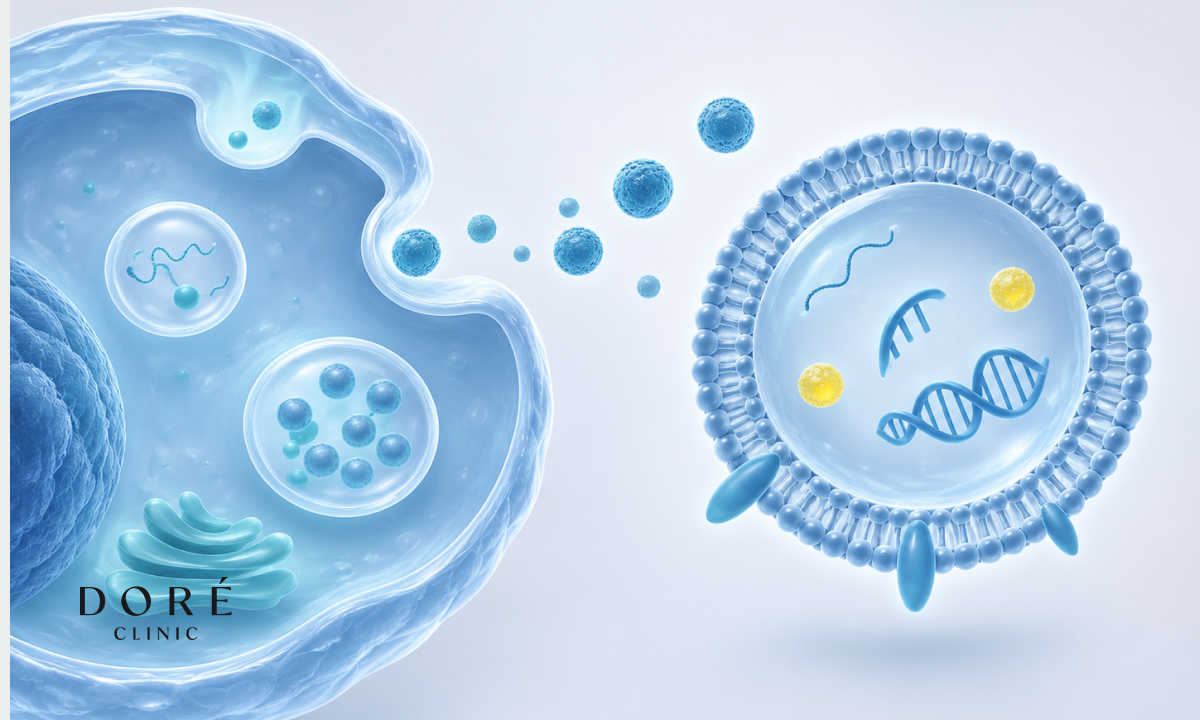
Q1. What is an exosome?
An exosome is a type of extracellular vesicle secreted by cells. It is a spherical membrane structure roughly 30-150 nm in diameter, with a lipid bilayer on the outside and proteins, lipids, and nucleic acids such as mRNA and microRNA inside.
The pathway by which it is made is also distinctive. The cell membrane invaginates inward to form an early endosome, within which small vesicles are formed again to constitute a multivesicular body. As this body fuses with the cell membrane, the vesicles inside are released outside the cell — these are exosomes. In other words, they are not fragments that broke off the cell surface but structures made inside the cell and then secreted.
The most important function is intercellular signaling. Exosomes attach to recipient cells through surface molecules or receptors, or enter the cells and deliver their contents. The recipient cell then alters inflammatory responses or regeneration-related pathways according to that signal. This is why researchers compare exosomes to 'letters sent by cells.'
In short, an exosome is not a single specific ingredient but a signaling vehicle made by a cell. The contents differ depending on which cell it originated from, and therefore the source of the raw material determines the character of the product.

Q2. By what principle does it act on the skin?
Current research is mainly conducted on exosomes derived from mesenchymal stem cells (MSCs). The actions reported in skin wound healing and regeneration fall broadly into four categories.
Inflammation modulation — induces macrophages toward the regenerative (M2) type to lower excessive inflammation.
Promotion of angiogenesis — helps form capillaries and supports the supply of oxygen and nutrients.
Fibroblast activation — promotes the proliferation and migration of fibroblasts.
Extracellular matrix remodeling — participates in collagen and elastin production and matrix rearrangement.
There is also research on the anti-aging side. In experiments applying stem cell-derived exosomes to human skin tissue, there are reports of increased type I collagen and elastin expression, and results showing that collagen expression was restored and aging markers decreased in fibroblasts damaged by ultraviolet light.

Q3. What concerns is an exosome used for?
Exosome ingredients, in skin booster form, help with skin regeneration and improvement of skin texture.
Areas where texture has roughened, such as acne scars or pores
Skin that is slow to recover after a procedure
Cases with both fine lines and reduced skin tone
Soothing and recovery care after laser or lifting
Cases with dryness together with a feeling of reduced elasticity
An exosome is not a material that fills volume, nor a lifting means that pulls the fascial layer. If sagging is the main concern or volume is needed in a hollowed area, another treatment comes first. Also, for skin with inflammation or infection, or during pregnancy or breastfeeding, it is usual to postpone treatment.
Q4. How much effect and how long a duration can be expected?
The figures generally given during treatment are roughly 10-20 minutes of treatment time, cream anesthesia, immediate return to daily life, and a duration of about 6 months.
However, these figures vary with the product and the design, so it is difficult to generalize them as they stand.
Rather than guidance like 'if you receive it a few times it lasts a few months,' it is more realistic to judge by comparing photos of how texture and tone change at 2 weeks and at 4-8 weeks after treatment.
It is reasonable not to judge by a single session, but to check the response first and then set the next plan.
Q6. What are the side effects and precautions?
The reported reactions are at the level common to injection treatments. Swelling, bruising, redness, itching, and temporary warmth at the injection site are typical and usually subside within a few days.
However, there are points requiring particular attention with exosome products. Because the raw material is derived from cell culture, purification and aseptic management determine the outcome, and if storage or thawing procedures go wrong the quality can change.
The following points are checked for safe treatment.
We check the product name, manufacturer, domestic classification (cosmetics, medical device, human tissue), and the scope of authorization.
We check the packaging condition before opening, the expiry date, and the storage temperature history.
You must inform us of allergies, autoimmune diseases, medications you are taking, and whether you are pregnant or breastfeeding.
For about one week after treatment, avoid saunas, alcohol, strenuous exercise, strong pressure, and UV exposure.
If swelling or redness persists, if pain worsens, or if a change in skin color appears, do not press or apply ointment on your own inform the medical institution where you were treated and receive care.
Q6. How does DORE Clinic in Gangnam, Seoul approach this?
There are not a few clinics in Gangnam, Seoul that offer exosomes. Having many choices is an advantage, but in this area 'what is used' matters more than 'where you receive it.' DORE Clinic makes this the starting point of consultation.
First, we check the classification and the scope of authorization first. We explain what product is used for what purpose and under which classification it is managed in Korea, and we do not recommend use outside the authorized scope.
Second, we check the raw material and manufacturing information. We confirm the manufacturer, the originating cells, the purification process, and storage conditions, and record the usage.
Third, we keep the indication narrow. We recommend it when texture and recovery are the main concerns, and propose another treatment first for sagging or volume deficiency.
Fourth, we explain alternatives together. For the same purpose, a skin booster based on medical devices or human tissue with a clearer domestic authorization framework, or a regenerative laser, may be more appropriate.
We design the schedule so that consultation and treatment can be completed in one visit in Gangnam, Seoul, but we do not omit the explanation before treatment and the follow-up check after treatment. Recording the changes at 2 weeks and at 4-8 weeks to adjust the next plan serves the same purpose.
Of course, we cannot guarantee the same results for everyone. Exosomes are still an area under research, and quality varies between products. We believe the role of consultation is to explain that uncertainty rather than hide it.
If you are considering exosomes, rather than which name is famous, first check which product is used and on what basis.
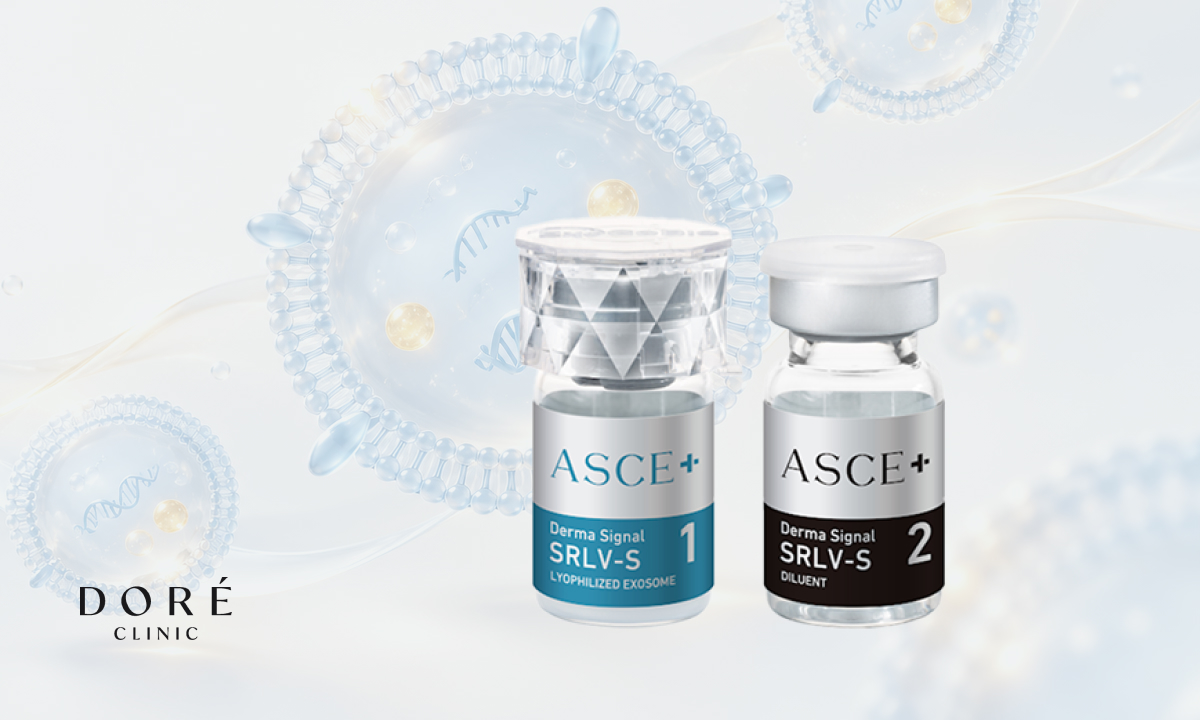
DORE CLINIC | Exosome
이름보다 먼저, 분류와 근거를 확인합니다.
Before the name, check the classification and the evidence.
Ask about an exosome treatment consultation at DORE Clinic in Gangnam, Seoul.

Doctor · Lifting Center, Anti-aging Center
Consultation and Reservation Inquiries
Please feel free to contact us with any questions you may have.